
In the Tudor era, the administrative gaze was focused on the parish register. It was a crude but effective mechanism for transforming a living, breathing population into a legible resource for the Crown. By standardizing surnames and recording baptisms, the state began its long journey of treating individuals as throughput – assets to be quantified, taxed, and managed. Today, we find ourselves at the terminal velocity of this historical arc. The parish register has evolved into the large language model, and the village beadle has been replaced by the autonomous agent.
The Transition from Scarcity to Intelligence
For centuries, the primary constraint on power was material. To manage a population, you needed a physical bureaucracy – paper files, stone workhouses, and human enforcers. However, as discussed in the recent dialogue between Raoul Pal and David Mattin, we are entering an era defined by a new fundamental metric: intelligence per unit energy. This is not merely a technical milestone; it is a civilizational shift that mirrors the enclosure movements of the industrial age. Where we once enclosed land, we are now enclosing the cognitive commons.
This metric suggests that the ultimate game of the modern state and its corporate extensions is the efficient conversion of energy into predictive intelligence. When intelligence becomes abundant, the administrative capacity for surveillance and classification expands exponentially. The goal of the Exponential Age is not just to provide better services, but to achieve a level of societal throughput that removes the friction of human agency entirely. In this system, the individual is no longer a citizen but a data point to be optimized within a larger algorithmic model.
The Agentic Economy and the Loss of Friction
One of the most profound developments in this landscape is the rise of the autonomous economic actor. We are moving toward a world where the predominant users of the internet and financial systems are not humans, but agents. These digital entities, capable of executing complex tasks without direct oversight, represent the ultimate evolution of the bureaucratic ideal. They are workers that do not tire, do not dissent, and operate with perfect adherence to their underlying code.
As these agents begin to populate distributed networks and blockchains, the Total Addressable Market (TAM) for economic activity is rewritten. We have long miscalculated the scale of this transition by thinking in human terms. If there are billions of agents performing micro transactions every second, the volume of data generated is beyond human comprehension. For the administrative state, this is a dream of total legibility. Every movement of value, every exchange of information, becomes a permanent record in a centralized or algorithmically managed database.
Energy as the New Binding Constraint
If intelligence is the output, energy is the raw material. This explains the frantic global race to secure energy sovereignty. From China’s massive solar build out to the US push for domestic energy production, the objective is the same: to power the foundries of the new intelligence economy. This is the modern equivalent of the search for coal during the 19th century, yet the stakes are significantly higher. Without energy, the predictive models that govern modern life—from credit scores to biometric identification – grind to a halt.
The brand of Citizen Erased recognizes that this thirst for energy often comes at the cost of personal autonomy. Systems built for administrative convenience always prioritize the needs of the machine over the needs of the individual. As we build out the infrastructure for this exponential age, we must ask ourselves who controls the switch. If the state manages the energy that fuels the intelligence that defines your identity, where does your sovereignty reside?
The Robotic Gaze and Physical Enforcement
The final push of this enclosure is the projection of intelligence into the physical world. Humanoid robots are not merely tools for manufacturing; they are the ultimate expression of the administrative gaze. Equipped with AGI brains, these machines can monitor, categorize, and enforce compliance in the physical realm with a precision that human wardens could never achieve. This represents a new species of management – one that is stronger, faster, and more consistently compliant than any human predecessor.
We are told that these systems are built for our benefit – to perform the tasks we find mundane or dangerous. However, history teaches us that every expansion of administrative capacity eventually becomes a tool for control. The workhouses of the past were also pitched as a solution for social optimization, yet they functioned as mechanisms for the dispossession of the poor. The robotic fleets of the future may well follow the same blueprint, tidying the population and enforcing solutions under the guise of efficiency.
Reclaiming the Human: The Nature Off Ramp
In a world built around surveillance, classification, and throughput, how does the individual maintain a sense of self? The answer lies in the recognition of what the machine cannot replicate: qualia. Humans possess a unique cognitive style – a curious, ambitious, and often irrational way of processing the world – that resists the probabilistic framework of the algorithm. Our value lies not in our efficiency as data points, but in our diversified, high quality compute that exists at the edges of the system.
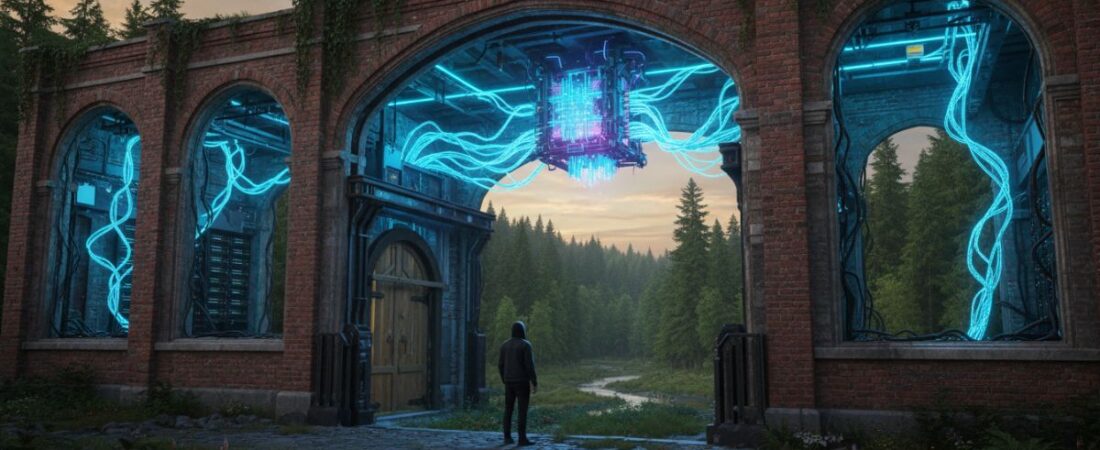
To resist being reduced to a datapoint, one must intentionally design an escape route. This involves leaning into the uniquely human – community, care, and a connection to the natural world. Nature serves as a grounding mechanism, an ecosystem that operates on a frequency different from the high speed oscillations of the exponential age. By stepping away from the managed world and into the unquantifiable beauty of the natural environment, we reclaim our agency. Sovereignty is a choice, and it begins with the refusal to be purely legible to the machine. We must remember that we are most vulnerable when we are least aware of the systems shaping us. Clarity is the first step toward freedom.


